Sunday, December 5, 2010

Visions, Conclusions and Definitions of sustainable communities

Visions

The readings this week focused on 'visions' and scenarios of sustainable communities. Common themes that arose in the reading include:

walkable and bike friendly streets, reduced or non-existent motorized vehicles and a high level of social capital


Achieving a sustainable community is a long-term goal and requires participation of all community members. Eliciting the type of participation that a sustainable community requires is, to me, the major hurtle facing communities right now. 

Conclusions

Now, at the end of this course, it is very clear how complicated the subject of sustainable communities are. There are many different avenues to achieve sustainability. In our class we specifically focused on how to become more sustainable in: Food, Water and Energy. I had never before considered, indicators, or ways of measuring sustainability. Furthermore, I realized how much local government support is required in order to make improvements. I never realized that issues, such as building codes would cause so much friction against individuals who are making an effort to move towards sustainability.

The closing ceremony, this past Friday, was a wonderful demonstration, of how thinking in a sustainable can foster interactions and good feelings between people.  Some of the people who visited our class's poster display seemed very intrigued by our recommendations. One man, in particular, asked for more information on our Starter Garden Program. I told him about BCOS and that these are recommendations made to the commission. I urged him to contact them and ask about our recommendations and if they are being used. I think that is a great example of how to get people involved and interested in what is happening in the community.

Definitions

This semester, I have  been presented with a variety of definitions of sustainable communities (many of these definitions, I have made note of throughout this blog).  Now, I present my own definition of sustainability:

Sustainability is the act of preserving our Earth with the intentions of providing food, habitat, and happiness for the current and future generations.

I think that this definition encompasses the basic need of acknowledging that it is the Earth that supports us. It also addresses the fact that being sustainable adds to ones 'happiness' and quality of life. It also shows that we must be forward thinking.  It is true that the definition can quickly become more complicated (as I learned in this course) however, I feel like my definition summarizes most what stood out for me this semester.

Saturday, November 27, 2010

Governing Sustainable Communities

I was happy to see a strong role of people and the local government with a underemphasis of federal government and lobbyists. One of the secondary factors associated with sustainable communities is the building of ties, social capital, among people. In other words:

In a sustainable community, people are caring about the environment, 
their government and each other.

I think Bloomington is moving towards the right direction with the Bloomington Commission on Sustainability (BCOS). Meaning they have an avenue for people to come and talk to the local government. Unfortunately, from what I can tell from attending a meeting. There doesn't seem to be too much community participation. Even the commission seems too overwhelmed with day to day life to work on outreaching to the community.  I hate sounding pessimistic, but I am wondering what steps need to be taken before you have a scenario as the one described in the book; where people in the community are being very active in decision making, building the local economy and social capitol. Looking at Bloomington, it seems like something is missing. It could be the population size, a transient population... I don't know. The chapter didn't even provide a concrete example of a community functioning like this.

Basically, in conclusion, I completely agree with the book that this is the way to go, I would just like to know how to get there.

Tuesday, November 23, 2010

Themester Event #3

Moving U.S. Climate Policy Forward: Are Carbon Tax Shifts the Only Good Alternative?
Friday, November 19
by: Ian Perry

First off, the presentation ended being completely over my head and not at all what I expected. The overall conclusion to the talk was:

"Carbon tax shifts may be the only economically sound investment for the U.S."

How Ian Perry arrived at this conclusion, I really have very little idea. His presentation assumed a basic understanding of economics, at the least. I have zero understanding of economics and was therefore lost by the second slide of the presentation. Ian Perry used a variety of graphs to describe carbon taxes and other types of policies.... Used a lot of words and abbreviations that I have never heard before.... I don't know. I thought this was going to be more of a scientific talk. So, sorry I can't give a better summary of the talk. If anybody else could tell me what was going on, I would appreciate it.

Themester Event #2

Film Screening of Food Inc. 
Wednesday, November 10. 


I'm posting about this kind of late... But, I will never buy Tyson chicken again! I went to the grocery store with a friend last week. She went over to pick out some chicken, and of course, the selection was dominated by Tyson products. As soon as she picked up a package, I freaked out on her. "Don't buy that!!" I shouted in the store. She and a few people standing buy gave me a funny look. I asked her if she had ever seen the movie, Food Inc.. Not surprisingly she said no. I told her that there was a reason that she was getting "more for her money" and that it wasn't a good reason. We compared the Tyson chicken package to the organic chicken package. Sure enough, the Tyson chicken was twice as big and twice as cheap as the organic. After telling her that Tyson feeds there chicken bucket loads of hormones and the ground up body parts of deceased chickens...she decided that she really wasn't getting the best deal buy investing in Tyson chicken. I'm not sure if she has seen the movie yet, but I at least felt that I had made some sort of impact.

I have to say, I have not been persuaded to become vegetarian or vegan. Rather, I understand that not all food is equal and that shopping with integrity takes some effort and education. I do appreciate this movie for providing some concrete research rather than just showing picture after picture of abused animals. Although, I have to admit that the scene with the downed cow getting pushed around by the tractor, was appalling.

I would definitely recommend this movie to other people who are interested in learning more about where their food comes from. I would also recommend the books by Michael Pollan, Omnivores' Dillema, and Jonathan Foer, Eating Animals. 

Sunday, November 14, 2010

Economic Development

For the most part, my brain starts shutting down when I am faced with the topic of 'economics.' I have never taken an economics class, and I have never really participated in a discussion of economics -- it is way over my head. Thus, when I saw what the topic of this weeks reading was, I was kind of thrown against a wall. After reading, I still feel a lost but I did learn some things:

What is economic growth?

What I can gather, it is a useless way to measure how 'good' things are going. It doesn't seem to be as comprehensive of a definition as it needs to be and is thus not very representative of what is going on.  The essay "The Economic System and Natural Environments" explained it basically as 'spending.' Not spending in a positive way but simply any spending. This was very enlightening but actually functioned to make me even more weary of economics.

Walmart.

In the next section, "Natural Capitalism", all I could think about was Walmart. I hate Walmart. Basically, the author was talking for a little bit about how business are moving toward being 'green.'  While reading this, I was thinking about how many conversations I've been in where I was telling people how much I hate Walmart. The number one rebuttal I keep hearing is that Walmart is doing a much better job with providing 'green' products. Well, no shit they are providing green products! It is what consumers want and if Walmart wants to continue dominating the economy, then they better provide 'green' products!!! Walmart isn't doing it because they care about the environment! They are doing it because they care about money! And that doesn't make them a better company in my book!

Government. 

A few of the sections talked about the size of the Government and how a move to sustainability can decrease the size of the government. I think this is a great thing, however, I couldn't help but think how much our government is trying to grow and control more of the private sector. In fact, it seems to me, at least with the current President, that this is what people want - a bigger government. But at the same time people want sustainability... a little confusing and counter-intuitive. The essay "Preparing for a New Economic Era" even said that the UN summits, focused on human problems, has been relatively ineffective at influencing a lot of change. Change needs to happen on the local level, not the federal, or even, global level. Change on the federal and global level will happen as local communities get it together. 

Imports.

Imports are pretty unavoidable at this point. Especially because we are all pretty much addicted to things like coffee and chocolate! But I think true sustainable communities should strive to limit imports on items that can easily be acquired locally. For example, why by a watermelon from Mexico in the mid-west?? The last two essays in the Sustainable Reader really focused on this topic. Moving away from imports will strengthen local economies and shrink the government even further. 

Conclusion.

The topics above are what stood out for me the most from this weeks reading. I'm pretty sure I'm on topic, but I think I really need to see what comes up in class on Tuesday. I am perfectly aware that there is a tie between natural capital and human economics. I have mostly just chosen to ignore the latter.


Thursday, November 11, 2010

After Wendell Berry's talk

Wendell Berry started his talk with us by providing his own definition of sustainability:

A sustainable community is "one that, so far as possible, would waste nothing. Would make things last. And would convert waste into fertility"  -- "as is true in natural ecosystems"

According to him, there are several ways to achieve a sustainable community. For example, you should keep money circulating in the local community as long as possible, and have as much food as possible produced locally and locally processed. These methods all stem to the renewal of household and local communities. Furthermore, the community must "conserve it's people" and "figure out who the gifted people are" meaning who has the knowledge and experience to implement new sustainable techniques.

Wendell talked about what communities were like back in the 30's and 40's. When talking about sustainability to people, I think it is important to stress that sustainability is not a new thing. According to him, the "idea of health use to be making things last, not spending, as it is today."  People seem to have become lost in the label of the 'consumer.' We need to be more aware and learn to accept what our earth can offer us and not what we think we can squeeze out of it.

Report: Global Warming Issue From 2 Or 3 Years Ago May Still Be Problem

The title of this article was enough to make me laugh -- "May still be a problem".... really, it isn't just going to go away as we continue to abuse our earth?

Wednesday, November 10, 2010

Wendell Berry is coming to class tomorrow!

Compromise, Hell! By Wendell Berry

Wendell Berry
This is an attention grabber! The essay begins "We are destroying our country!" One reason seems to be due to the 'submissiveness' of the American people. So how do we stop destroying our country, Wendell says that we need to care more about the economy -- specifically land use. Caring about the land can translate to pride in local businesses which can stem out to pride in our communities.

I have to say I agree with all the major points in this essay. This is the first essay by Wendell Berry that I have read and I must admit that I was shocked by the colloquial language coming from someone so well known and respected. For instance, when he states that "most of us are still too sane to piss in our own cistern, but we allow others to do so and we reward them for it" I laughed. How true and to the point! We do need to get angry at how we are being treated and how we are treating our earth and we need to stop rewarding those that stand in our way!


Environmental Justice and Social Equity

To be honest, I never have considered the question "Do minorities care about the environment." In fact, I after reading the essay by Robert Bullard, "People-of-Color Environmentalism", I still think it is a stupid question. A more intelligent way of looking at it is the resources and abilities people, not just minorities, have for making a difference. This may just show my ignorance on this aspect of sustainability, but since when is environmentalism about "check writing, paying dues, and membership in environmental organizations?" I'd like to talk to who ever came up with that definition... I have heard many definitions of sustainability and environmentalism and I have NEVER heard any mention of money. To me, sustainability and environmentalism are what results from people caring about their environment and community. People can show they care through avenues such as donating to the next green project. But they can also be less obvious than that. For example, recycling, educating others, being educated consumers. I'm almost a little offended by this reading, I'm not a minority and I have never written a check. Well, I am a member of the Ecological Society of America but I was a member long before I knew the definition of sustainability.  One last thing on this essay, I think the grass roots movement is a more down to earth way for people to express themselves than through money. And people definitely have a right to breath clean air! I totally agree with that.

"Domesticating urban space" by Dolores Hayden, was similar to the previous article in that I never thought of 'woman's rights' as being linked to sustainability and environmentalism. Woman's issues aside, I think feeling safe is an issue for everyone. Women and children are in as much need for a social atmosphere as men, and all those needs should be addressed as much as possible by the city and transportation planners.

I think our in class exercise summarizes "Fighting poverty and environmental injustice in cities" and Rosland's "Housing and Community Development." Most interesting to me is how much resistance to equitable cities comes from other, better off, citizens. This, to me, is an example of what is opposite of sustainability. In the previous readings, we are talking about how the 'majority' are the people who are acting more environmentally, this reading, seems to contradict that. (Which is probably another reason why I was so confused by the previous readings). I think a lot of cities are trying but the "not in my back yard" way of thinking is excluding people... not just nuclear power plants (which is a little more understandable."  In addition, it seems to me that people like to blame the government for the reasons why things aren't working but perhaps people should consider their own communities a little closer.

Saturday, October 30, 2010

Land use and Urban design

See earlier posts on "The Next American Metropolis" and "Outdoor Spaces and Outdoor Activities". I already wrote quite a hefty amount for each of these readings.

"Infill Development"

This section was pretty interesting to me. I have often been in a city and seen a neglected plot of land and thought, why doesn't anybody do something with that.  Learning that one of these reasons is because the land is 'too toxic' is extremely alarming! I think the reasons for Infill development are pretty straight forward, at least to me. I think more attention needs to be placed on why it isn't a common practice.


Here are some pictures of infill development. Top are some affordable housing and bottom is a nice 'green' space. These are much better looking than this:


Rosland argues that issues related to land use are tied to all other types of sustainability issues, especially transportation. In effect, this is a very important topic that needs to be addressed in communities that are trying to move towards sustainability.

Wednesday, October 27, 2010

A trip to Barnes and Noble

On Monday, I went with a friend to Barnes and Noble. She had just received a position in the sustainability office as an intern and was looking to purchase some sustainability books to help her become more acquainted with the topic. We arrived at the store and started looking around for a section on 'sustainability', 'conservation' or something like that and quickly realized that a section like that did not exist. I found one of the store workers and asked where I could find books on sustainability. He looked mildly confused for a second and proceeded to lead me to the 'nature' section. After a brief look in the nature section, my friend and I were still without any books on sustainability. We then continued walking around for a little more and finally found what we were looking for under "Cultural Studies." At this point I began thinking, 'why is sustainability considered a cultural study? Surely it is more of a science and should be listed with the books in the Earth Science Section.' My friend found one book she was looking for but was still not very satisfied. We walked back to the 'Nature' Section and found the 'Natural' sciences section which had a fair selection of books on carbon increases including 'An Inconvenient Truth.' After my friend selected one more book, we check out and left the store.

I think this trip is a real example of peoples' confusion over the definition of sustainability -- Is it a science, a cultural, a myth... who knows! I could agree that it is both a science and a cultural, but I certainly wouldn't expect to find books under 'cultural' studies. It makes the topic seem like more of a fad than a science which, to me, indicates that sustainability is still one of those topics that has yet been acknowledge to hold some type of scientific backbone. This is a real problem when we are trying to move people on this topic quickly in order to initiate change.

I'm thinking 'sustainability' needs its own shelf in the bookstore.

Saturday, October 23, 2010

Transportation

The Rosland Chapter was a great summary of what I read in the sustainable reader:

From, "Transit and the Metropolis: Finding Harmony", I really found it interesting just how many different types of transits there are. Personally, the only mass transit that I have ever ridden and actually enjoyed was the metro in D.C.. But, apparently there are only 12 metros like this in North America. Furthermore, the world bank is hindering the development of these types of transits. I have ridden the bus in Bloomington, and I have to admit -- I hate it!! I feel so vulnerable, crowded, uncomfortable, worried.... I would rather walk a half-hour or bike 10 min to class than ride one of those buses! I think that the system needs to address issues, like those I listed above, in order to coax more people into using the system. The reason I enjoyed the D.C. metro so much was because I felt more secure in it than I did walking around town or trying to drive. The metro system there is also very accepted. I feel like everybody was using the transit.

If you can't get people on the transit system, then encouraging them to get out of the car and walk is another possibility. The essay "Traffic Calming", describes ways to get people to set aside there fast paced modes of transportation and enjoy their town. I think Bloomington streets, especially streets like Kirkwood, are good examples of what this essay is trying to describe. Pedestrians definitely outnumber the cars on that street. I love the atmosphere and energy of Kirkwood. The lack of parking and the closeness and variety of shops really help to encourage people to walk.

I am was very happy to read some of the ideas in "Bicycling Renaissance in North America".  As I have mentioned in a few of my older posts. I use biking as a means of transportation for everything! Getting to school, work, friends houses, errands. I went to pick up a pizza on my bike last week and had a whole lot of fun trying to get down North Walnut balancing a pizza and trying not to speed out of control! It's do-able and it makes things a whole lot more fun! I like biking for the fitness aspect, like the article states. When I first started biking in Bloomington, it took me 15 min to get to class because I tired out so fast over the hills -- I can now do it in 10 min!! It's great! I drive my car only once a week out of town for my weekly horseback riding lesson -- that's it!  Despite all of these benefits, I do agree with the author that motorists need to be more accepting of bicyclists. I have almost been hit no less than three times by motorists who simply don't seem to register that I am there. Furthermore, bicycling does have a lot of cardiovascular benefits, however, I almost suffocate everyday behind cars that emit lots of smelly gases from their tail pipes! Why is there no emissions check in Indiana????

Wednesday, October 20, 2010

More on climate change and sustainablity

"First Living Building Challenge winner" article

I think my favorite part about this building -- other than it being a leader in green buildings-- is the visual picture I received when it was being described to me. They have a waste water treatment system IN the building!!! Which is disguised as a happy little greenhouse! Great stuff!

"Baggage: The Case for Climate Mitigation" pdf article

I love how the author compares climate change to Napoleon invading Russia!!! It is so creative and really illustrates the point. The author states that there is "a human tendency to react to, rather than anticipate, events." This a very true statement and one that may help explain why there has been such a lag in reactions so far. When giving the choice to adapt or mitigate, the author votes that " adaptation, must be a second priority to effective and rapid mitigation that contains the scale and scope of climatic destabilization." I can agree with this and it seems to be the way of things thus far.

 "Hyatt Regency skywalks designer Bob Berkebile is the godfather of green building"

The most interesting aspect of this reading was the personal change that Bob Berkebile went through. It the changes in his favorite cars to drive was more revealing to me about his love for the environment because it didn't seem as work-related to me; more of a personal choice. I think Americans could learn a lot from his story. For one, not everything needs to be flashy! We don't need Porsche's to make us happy!!  I can really respect Berkebile for coming out of such a terrible experience and giving back to the community and the planet in a wonderfully positive way. 

Monday, October 18, 2010

Global Change

"Atmospheric Change and Air Quality"

I'm so happy that this article explained other greenhouse gases besides CO2. I feel that people get lost in global change as being all people's fault for driving too much but there is way more involved than just that. We are learning about these concepts in more detail in Environmental Chemistry, right now. One of the most commonly overlooked reaction involves the CFCs and ozone. I don't know about the majority of people, but I remember ozone depletion being a really big deal when I was in middle school. Then the whole thing just kind of disappeared and now people are all concerned about global change and are forgetting how complicated environmental science -- and especially how complicated atmospheric chemistry is. The take home message is: don't forget to look at the whole picture when deciding how to mitigate climate change!

"Stabilization Wedges: Solving the Climate Problem for the next Fifty Years with Current Technologies"

The nice thing about this article is that it combines both concepts of sustainability and climate change.  The concepts of sustainability outlive the acceptance of climate change (at least to me).  In an optimistic approach, one way to rally more people to think sustainability is to show them why -- global change is a perfect illustrator to convince people why sustainability is a good idea. Things like, reducing, recycling, green buildings and living more simply have all been discussed already without showing how it is linked to global change. In other words, if you can't convince people to be more sustainable for reason like "increasing quality of life,"  "preserving for future generations," or other 'happy' reasons like that, you can scare them saying "if you don't become sustainable now, then in 50 years you are going to sweat to death" or "in 50 years you will have to walk 50 miles to work everyday."  The scare factor can be pretty effective!

"Confronting Climate Change in Indiana"  pdf


Speaking of scare factor...More frequent extreme heat episodes, deadly heat waves, poor air quality, more frequent droughts (aren't we in one??), more frequent down-pours and flooding, lower water levels, stressed crops and livestock...this is not a happy pdf.  However, the solutions are very similar to those of the Wheeler article (noted in the above paragraph). 

Conclusions from reading

The effects of Global Climate Change can be mitigated but it can not be done passively. One of my frustrations is that people are still asking the question "do you believe in climate change" which to me sounds like the question "do you believe in aliens?" or "do you believe Elvis is still alive?"  We are running out of time to keep this debate going. If people refuse to be more sustainable because they don't believe in Global Climate Change, then we really need to work as a community to move them on other reasons to become sustainable (the reason are plentiful!!).  This is the way to mitigate Global Climate change in all regions, not just Indiana.

Tuesday, October 12, 2010

Green buildings

"Design, Ecology, and the making of thing"

The most gripping section in this reading, was when the architects were looking for a tree to replace the beams that had dry rot, and they found trees planted 350 years ago for that purpose. This is a concept that I never really thought about and I am very happy to have run across it in the reading. This is the definition of sustainability -- Everything coming full circle -- thinking about the future -- and preparing for the future. For me, it adds another dimension to the definition of a green building. A building is not done once it is finished being built, to be truly sustainable we need to think further down the line.

I also think the section about the kids getting too hot and not knowing to close the shades or open a window is important. Like the author says, children are alive, they can learn and also be involved. It is our job to teach them.

"Principles of Green Architecture"

The principles of green architecture are fairly simple: conserving energy, working with climate, minimizing new resources, respect for users and site. The first three are pretty obvious and I have read about them in detail in other sources however, respect for users and site are some what new concepts to me. Moving from a nomadic life to a sessile life not only changed what materials we use to build shelter, but how we think about those materials i.e. how else might we use them. It is funny, most people would probably see the argument that most people in America are removed from nature but how about removed from their homes. I have no idea what goes into building a home. Something so basic and I have absolutely no idea what it is about. I think the principle of having respect is a first step towards understanding.

"Sustainability and Building Codes"

Ah!!! I made a post about this yesterday! It is quite a shame when a person finally gets over the barriers to going green, and then is met with building codes, and insurance companies -- what a shame! I am sure that community pressure will eventually create some loop holes in these policies.  It is just too early to tell. If cities are really interested in encouraging residents to build more green buildings, then the cities need to take steps to remove these barriers from the codes.

Apartment Gardening on the Balcony

Apartment Gardening on the Balcony

Sunday, October 10, 2010

Can We Build in a Brighter Shade of Green? From the New York Times


http://www.nytimes.com/2010/09/26/business/energy-environment/26smart.html?_r=1&scp=1&sq=%20%E2%80%9CCan%20We%20Build%20in%20a%20Brighter%20Shade%20of%20Green?%E2%80%9D&st=cse

Here is a story about a private home owner investing in a green home. My favorite thing about this story is how the insurance provides declined these people because they wouldn't have a furnace in their home. This just brings to reality how much more change is needed to switch from conventional to 'green' ways of building.

Saturday, October 9, 2010

Solutions to our energy "addiction"

The United States and Canada use more energy per capita than any other nation. This use is so extreme that it has been termed as an "addiction." This addiction has resulted in inefficient technologies for heating, cooling, lighting, and ventilating our businesses and homes. These inefficiencies have lead to increases in taxes and decreases in local revenue.  This addiction has moved out of the local community and has started to affect our natural environment through resource depletion and global climate change.  But it doesn't need to be this way!


New technologies for building 'green' buildings and alternative technologies for heating, cooling and lighting not only save our environment, but saves us money.  This is where a lot of Americans get lost.  My parents, for example, are convinced that global climate change is a fabrication of politicians, designed for the soul purpose of squeezing money out of middle-class Americans.  The figures simply don't support this. The table on page 92 in Roslands book, outlines that savings that the city of Phoenix experiences from Energy saving projects.  Top of the list was a yearly savings figure of 418,879 dollars in the Civic Plaza. That is a HUGE amount of money. The reinvestment of this money could be used toward countless other avenues. What is the federal government were to make these changes? Maybe we could get out of dept.


It may be one this for governments to make these changes, however the initial cost of these projects, may be too great for private home and business owners to absorb, even with the promise of payback.  These technologies can still be utilized at a smaller scale and installed in new businesses and homes. Even 'small' changes made by enough people can have an enormous impact. 


Saturday, October 2, 2010

What to do with all that Urban Waste?

"The Metabolism of Cities"
One type of pollution we haven't really talked about is Light pollution. The section on 'energy' in this reading touch on this a little bit -- That from space we can see the glow from cities. This type of pollution is one that is often over-looked. I never heard about it till the National Geographic did an article on it some time ago.


Although the reading talked a lot about sustainable ways of creating energy, I was really hoping that it would get back to what it mentioned about being able to see the light from space. There are interesting environmental impacts of 'Light pollution.' Just look at how many plants are illuminated, how many bugs flock to the street light, and how dependent we are on having a source of artificial light at night, instead of letting our eyes adjust naturally.

 It is funny that this article focused so much on energy and how we can move from a linearized model of consumption to a circular model of consumption as found in Nature. I really liked this analogy to waste reduction. I also liked how the author addressed the 'not in my backyard' view to waste disposal. It seems to me that cities really have no other choice but to start disposing of it locally, when all the other areas are overrun.

"Waste as a Resource"

The thought of transporting waste to deserts never crossed my mind...And for good reason! The reading explicitly explained that aerobic environments with bacteria and fungi are needed for decomposition. One of the images that comes to mind when I think of a desert are mummies -- Perfectly preserved organic bodies that are several thousands of years old. Sending waste to desert may make the garbage disappear via the 'out of sight out of mind' definition of disappear -- But I highly doubt that the garbage can physically disappear in a desert.  

Other solutions are incineration, which sounds bad, but I actually favor this for all un-recyclable materials. One of the arguments against this is that it concentrates pollutants. My response is that this is exactly what natural decomposition will do -- this just does it faster and uses less space. If pollutants in the trash are a problem, then I feel that it is best dealt with before an item is manufactured.

I am intrigued that water pollution as a result of waste is brought up time and again. Wetlands are magical places :) ! But as the author warned early on, the capacity of water bodies to assume organic waste is a function of population size. I just worry about the sensitivity of these ecosystems.
 

Reduce - Reuse - Recycle - (Recover)

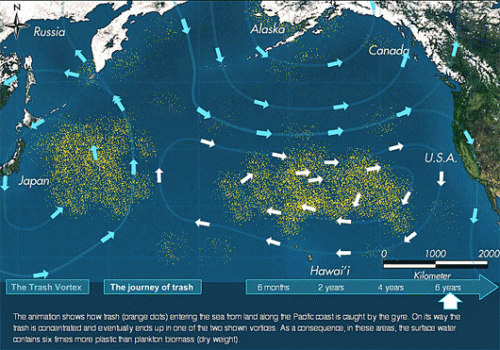
Last week in Environmental Chemistry, I learned about the big circling collection of garbage in the oceans. The whole time I was reading ch. 6 of Rosland, I had this picture in my mind. It is really disgusting to see this amount of trash and it perfectly exemplifies how much trash we have and how much it is out of control.  There are initiative to remove this trash but the problem is that it just comes right back due to the movement of the ocean currents. Here 'recovering' isn't really an effective answer to the surplus of trash.

The reading brings up an interesting point, people are so focused on recycling and recovering, which are the last of the (four) R's. One of my favorite initiative to reduce is the 'think out side the bottle.' I have saved SO much money not drinking bottled water/tea. I have a britta filter at home and I brew my own Ice tea. It is really not as inconvenient as people might think it is to carry around your own water instead of purchasing it. Not only does it save money, but, in light of the reading, it has a major effect on the planet. We shouldn't need to invest in so much recycling if people would just 'reduce' a little more.


The resistance to change that Americans have toward the environment is crazy. Instead of changing we implement new technologies for recycling and recovering. Like the book says, this kind of misses the whole point of sustainability. We have to change our lifestyles if we are going to be sustainable. Programs like recycling are only a short-term solution. I signed up for the think outside the bottle challenge about two years ago. I can probably still count on two hands the number of water bottles that I have purchased -- I'm pretty proud of that!

Monday, September 27, 2010

Help Rename High-Fructose Corn Syrup

This reminds me of some of the food issues that have come up.  Subsidies on crops, such as corn, make eating locally an expensive alternative. Furthermore, these subsidies have left the market with an overflow of corn products -- What to do with them.

Follow the link to see more:

Help Rename High-Fructose Corn Syrup


Saturday, September 25, 2010

Ecosystems and Human Well-being: Wetlands and Water

Well this is interesting, especially considering that I am studying for an exam in my wetlands class for Monday!  Some of the 'Key Messages' in Ecosystems and Human Well-being: Wetlands and Water touch on the vastness and the importance of wetlands. Reading about how much wetlands are in danger of degradation is quite disturbing. Even more so when one realizes how few of the original wetlands are still here. I'm from Ohio and the literature states that Ohio has lost 90% of what was originally there pre- european settlement. Wetlands are targeted for their incomparably fertile soils and their resources such as peat. To me the the loss of wetlands is similar to the loss in oil. People find an irreplaceable resource and go at it like a starved dog.

North America is doing a very good job with wetland restoration. I just visited the restored wetland on campus this Friday!  There are many laws now in place for the protection of these habitats. The trick now is to get the general public to see them as necessary and valuable ecosystems. Unfortunately, terms like 'bog' and 'swamp' have negative connotations - BUT THEY SHOULDN'T! In this case, more education is definitely needed, keep the laws coming but,  people need to be reconnected to lots of different forms of ecosystems.

I really hope to be able to read this whole report, but since it is 80 pages and there are too many exams in the next few days, it'll have to wait. In the mean time, I'm curious for the discussion on Tuesday.

Water and Sewage

The only thing that really caught my attention, while reading the chapter from Rosland, was how many financial incentives were being used and how many laws were implemented. Out of all the issues we have read about so far, this issue seems to be making the most head way. I can't help but to wonder when such incentives and laws are going to be drafted in order to curb peoples carbon budget -- I already know there is some talk about it. Or, (gasp!) what if governments start doing the same thing to get the population to decrease. Imagine: if you have more than 2 kids -- FINED! It may not ever come to that, my imagination is running wild today, but I just couldn't help thinking about it.

I guess what I'm trying to say is that I'm kind of disappointing that people can't be motivated to make changes on their own but must instead be given the 'stick.'

I had to take microbiology as part of my major in college and we joyously learned about waste water treatment. My impression from that class was that it was a very 'green' process, sludge is allowed to settle out via sedimentation. The sludge goes on to be used as fertilizer, and the rest of the water gets cleaned by micro-organisms or, perhaps as a final stage, UV light. The whole, 'heavy chemical' thing to me seems completely unnecessary. Especially when reading about how effective wetlands are at removing excess nitrates and phosphates.

Wednesday, September 22, 2010

Peak Oil Task Force

Peak Oil Task Force Report: Redefining Progress  can be found at http://bloomington.in.gov/peakoil 


The article says that we may reach global peak oil with in 15 - 20 yrs! This task force is trying to find ways to mitigate oil use. The mitigation of oil use is important for many reasons which are not limited to: reducing pollution and the greenhouse effect, reducing dependence of foreign countries for energy and to reduce the use of a non-renewable source. These reasons aren't even taking in to account peak oil.  The scary part about this peak oil time line is that it falls right in the middle of my life-time.  I really don't want to think about how it will effect my life... All I can guess is that a complete change in energy use is needed ASAP to make the change from oil more smooth. 


I like that Bloomington's task force is collaborating with other cities, after all, this is a global problem. 


The pdf is available here: Re-defining process

Whatever happened to walking to school?


My mother loves sending me little articles, pictures and whatnot along with any letter's she sends me. The most recent of these I have scanned an posted above.  I really think this fits in the suburban mindset. I can just picture a neighborhood, with the garages in front of the house. The car leaves with the kids in the car, and comes back with the kids in the car -- but you never actually see the kids.  I also think this has to do with reducing a carbon footprint and improving the quality of life by not driving to school/work.

Sunday, September 19, 2010

Greening the City - Ch. 4

'Greening the City' means "combining urbanism and nature to create healthy, civilizing, and enriching places to live."  It is important to realize that the simple act of 'greening the city' is not the same a sustainable development. Urban development must acknowledge biogregionalims which are regions defined by things like biota and topography (exempts human factors). This ensures that green spaces are not unsustainable by demanding inputs like irrigation and fertilizer.A common urban green spaces are urban parks and the private backyard.   Once green spaces are made in a sustainable way, they begin to benefit urban society by offering things like shade and sinks for carbon. Other benefits can increase the sustainability as a whole. These benefits include, but are not limited to: decrease energy costs, reduced urban heat island effect, decrease water use, increase absorption of pollutants and increased urban wildlife habitat.  There are many other benefits listed in the reading. Personally, these green spaces are important to me because they act as a type of stress reliever. Going out into green spaces for a walk or sitting on a blanket studying are very effective ways to reduce stress. Sure there are all kinds of economic benefits to green spaces, but I think strengthening the community is very important.

There are several types of initiatives for the building of green spaces and for trying to get people out of their houses. One initiative that I heard of was a program called 'no child left inside.'  This was taking place at a local arboretum. Honestly, when I first read this, I was kind of surprised. I was never inside while I was growing up and it is sad to me to think that kids aren't enjoying nature. I guess it isn't too surprising when you think about kid's dependence on technology in today's society, but for things to be so bad where we are trying to 'save' them. I was in college, and as part of my class, we visited an organic farm. One of the girls in my class (at least 21 years of age) had never seen a chicken before!! How do you make it to the age of 21 and never see a chicken? Weird...

This kind of brings us to the next sections in the reading: Urban agriculture and urban aquatic systems. It is important for people to know where their food comes from, or they go their whole lives without ever laying eyes on a chicken. It is common knowledge that food brings people together. My group of friends and I purposely make sure that we cook one meal together each week.  You really learn more about people and appreciate your food and health more because of it. Teaching people how to grow food instead of buy it is the same as teaching people how to cook instead of heating things up in the microwave. This is an age of staying indoors and eating microwave dinners -- No wonder our life expectancy is decreasing. 

Saturday, September 18, 2010

Urban Ecology and Restoration

"City and Nature" by Anne Spirn

Refers to the city as a 'granite garden' which is nestled in a larger garden. This is an interesting metaphor which brings to mind some interesting mental pictures. I picture limestone like blocks that are almost covered by large trees -- a sort of miniaturized city. I have to say that as I got to the end of the reading, I didn't really have a better grasp on the city as a 'granite garden' more as some sort of spoiling thing that contaminates... I really was hoping to get a better grasp of this concept of a 'granite garden' than I did.

Further in the reading I came across the statement: The city "in not unnatural but , rather, a transformation of wild nature by humankind to serve its own needs." This is the first time I have ever heard of someone referring to a city as "natural". I have always heard the argument as a city being almost the opposite of natural.  Embracing the view of a city as part of nature is being argued as the one of a few ways to slow or stop the degradation of the environment. If people become aware of nature in the city, perhaps they will also become aware of the city's impacts on nature.

Furthermore, the author elaborates on select cities which are already suffering from ignoring nature in the city. Most common amoung these issues are issues relating to water -- flooding, mudslides, sinking.  It apparently takes compressive solutions to deal with many of the issues associated with cities and this starts with understanding nature. Until then, cities will continue to affect plant communities, hydrology, and air and water quality.


"Land Development and Endangered Species: Emerging Conflicts" by Timothy Beatley

Biodiversity loss is commonly interpreted as something that happens elsewhere, with little emphasis to biodiversity loss in our backyards. The major contributor to biodiversity loss is attributed to land-usage issues and is especially correlated with population growth

There seems to be a silent battle insuing between conservationists and Urban Developers and there are there are many questions that are associated with balancing urban development with conservation. Among these are "what is the best strategy" in both the ecological and economic sense. I personally don't see any clear cut way to solve any of these problems. The most blaring issue to me is the population growth. This essay says that the current population size is 5.4 billion and many expect it to reach 12 billion before it levels out. I do not see anyway that the earth can sustain that large of a population!! I hope I am no longer around if/when that ever happens. The quality of life would be terrible!
The benefits of protecting biodiversity include" Human uses both medicinal, emotional and commercial, protection of intrinsic values of life and protection of ecosystem as a whole.  I can't not imagine these benefits surviving in a world of 12 billion people!  Hopefully a balance between conservation and urban development can be found. And hopefully people will stop having children.

"What Is Restoration" by Ann L. Riley

Ecological restoration is "the process of intentionally altering a site to establish a defined indigenous, historical ecosystem." There are other definitions which include things 'like reversing the human impact.'

Restoration is something that is personally very interesting to me, it is what I want to do when I am done with school. This essay brought up many aspects of restoration that people very commonly question. One of these is 'what do you restore it to?' Sometimes this is a very hard question to address to to land-use change and degradation.  An area that was once a wetland but is no a dried up agricultural field may be very difficult to restore back to a wetland. Furthermore, restoration encompasses very complex ecology and requires the inputs or several different experts in different scientific fields. This makes the process very time consuming and sometimes very expensive.

Despite these hurtles, the benefits of restoration are worth it.  Not only are you restoring a landscape, but you are making habitats for animals, resetting hydrology, carbon sinks, and natural filters of pollution.

Two years ago, I worked on a stream restoration project with a local arboretum. Prior to this experience, I had no idea what restoration was. I quickly learned that it wasn't simply "planting a whole bunch of trees" just as the book says, there were so many maps, delineations and  experts. Things like, deciding where to get the rock from, the contours of the stream and the plant species to introduce to a lot of time and effort. Even after the project was completed, one of the banks washed out and had to be fixed. It is a crazy process and can take many years of succession before the area is successfully "restored." None the less, I feel very strongly about the benefits of restoring areas, especially wetlands and prairies since they have been targeted by development.  These areas have suffered major losses. I am from Ohio and I know that 90% of the original wetlands are gone. The land that makes up the corn belt was once a vast wetland home to many species of migrating water fowl. To protect biodiversity in light of over development, some un-development needs to take place.

Wednesday, September 15, 2010

"What is an Ecological Footprint?" from Sustainable Reader pg 289

According to the read an ecological footprint analysis is "an accounting tool that enables us to estimate the resource consumption and waster assimilation requirements of a defined human population or economy in terms of a corresponding productive land area." 

I loved the question "what would happen if a glass bubble was placed over a any city." I is kind of morbid but it really accentuates the fact that cities can not sustain themselves -- they are utterly dependent upon outside resources. The second question, 'how big would the bubble need to be to include all needed resources' is really  just asking 'how big is the ecological footprint?'

Basically, if everyone on the planet were to live as the average American, we would have used up the Earth's resources a long time ago. By putting a value or a 'footprint' on an individual's life style, it is much easier to provide comparisons and then incentives for reducing ones consumption of natural resources.

My ecological footprint anaylsis

According to the  Global Footprint Network:

http://www.footprintnetwork.org/en/index.php/GFN/page/personal_footprint/

"If everyone lived like me, we'd need 3.7 earth's to support the resources"

" To support my life-style it takes, 16.5 global acres of the earth's productive area"


My personal Greendex score according to National Geographic is:
53

 ______________________________________________________________

 Ecological Footprints relate to the earth's carrying capacity by showing people how many resources they are using relative to the resources that the earth can supply. These calculators seem to place a lot of weight on food, transportation and water use. I really liked the Global Footprint Network much better than National Geographic's calculator. I think the Global Footprint Network was more intensive and took into account more details about living conditions and even asked about clothes and recycling. Whereas National Geographic didn't ask that.

As far as lowering my footprint, I think the most dramatic thing I can do is to change eating habits and eat less meat and eat more locally. This is easier said then done considering food at farmer's markets is expensive and I don't have a job. On the other hand, I ride my bicycle everywhere, I haven't purchased a bottle of water in about 2 years. I recycle plastic and aluminum. So, Ideally I would like to start eating more locally but I need other things to happen first.

Theme - ester kick-off event last saturday

I just thought I would take a moment to comment on the kick-off event for theme - ester.

Free food and music are always a good thing! I checked out many of the tables. There were several on worm composting and alternative energies. I spent a while talking with a lady about bike and pedestrian paths in Bloomington. She had a chart with all these pictures of different qualities of paths. I was intrigued to see pictures of families who were so set on being outdoors that they were walking in the middle of the road with baby strollers! Where there is a will there is a way, I guess.

One note of criticism ... I was kind of disappointed with the level of energy at some of the booths. Several people didn't say a word or I had to really try to get them to talk to me about what they were doing. I just expected to see a little more passion from some of the people than I received.

The Farmer's market on Sunday was really fun!! Even though that wasn't part of theme - ster, it had the energy I was looking for.

BSCO meeting Sept. 14

The 'food' committee's major focus is to 'understand and promote local food production.' The committee has several goals which include:

-A survey of organizations to see how they promote and use local food

-beginning a garden program which will help people to set up gardens. This project will need to compare Bloomington to other cities and their local gardens and food production. This project will also need to look at indicator.

-Figure out how many acres ore being used for agriculture production (both public and private.

Personally, I am excited to help out with the garden program!!

Monday, September 13, 2010

Sustainability Indicators

Virginia Maclaren described sustainability indicators as means for measuring a communities progress toward sustainability. In the urban setting, indicators must be developed with input from multiple stakeholders in the community. In addition, urban sustainability indicators must be integrated, forward-looking and distributional.

Some examples of indicators include: number of good air quality days per year, gallons of water consumed per capita, and library and community center usage rates.

In Bloomington, a sustainability indicator could be a measure of the number of people who travel via the transit system. This would affect the amount of gasoline consumed per capita. While I can't say what this percentage is before, I know that I have lived in bloomington for a month now and have personally not used more than an 1/4 tank of gas from my personal vehicle. I know many of my friends have opted for using the bus rather than deal with the traffic and parking issues. The use of the public transportation system fits with the 'population and resources' section in figure 1: sustainable seattle indicators. This is only an indicator if the gas usage is going down, which I think it has in Bloomington based on my personal experience.

Saturday, September 11, 2010

The Sustainable Reader - "Infill Development"

I was surprised to hear about all of the hurtles set up against "Infill Development." It seems a waste to develop perfectly good land when land already exists that has been degraded. Many of these hurtles, especially all of the economic ones, are easily removed. I feel like this is one of those examples where the public needs to be informed so that they can push the local governments to change. If financing is really such a hindrance, and the general public wants to rethink these empty urban spaces, it seems that a simple vote could change the problem.

One issue that I don't really understand is the 'Displacement' that can result from Infill Development. I suppose it makes sense in a way but thinking about displacing poorer communities sounds like an issue that shouldn't arise in the first place. It seems much more effective to turn an old broken down parking lot into cheaper housing than to go build expensive condo's somewhere else. I think the movement toward at Transit-Oriented community requires that cities rethink unused plots of land.

I have always wondered why there were so many run-down buildings in the center of a city. I don't think people really want to be walking around in a neighborhood that is inundated with areas of degradation. As I said, it seems to me that this issue is one that could easily be resolved.

Toward's Sustainable Communities - Making Community Policy

Policy Instruments come in four categories: Regulations, Voluntary Instruments, Expenditure and Financial Incentives. Policy Instruments are need in sustainability initiatives to provide incentives for the public to use more sustainable methods. The goal of Policy Instruments are to reduce the consumption of natural resources. However, It is very difficult to convince someone to change their way of life without any motivation that says the switch is somehow profitable. This is where the categories and Instruments come in.

Regulations are "the most pervasive policy instruments." As far as effectiveness, I don't think this is the most effective way of encouraging people to be sustainable -- It is very uncommon for people to like being told what to do from something as impersonal as the government. I do acknowledge that this may be the only way to "get the ball rolling" so to speak.

Voluntary Instrument give me a picture of a pro-active community and the sort of thing that I would expect in Transit-Oriented Development (TOD) as described by Peter Calthorpe in "The Next American Metropolis." Voluntary initiatives can be increased by increasing education on environmental and sustainability topics.

Expenditure "consists of any use of public money such as contracting, monitoring, investment, procurement, enterprise, and public-private partnerships." This ties in with the earlier reading again by Peter Calthorpe and the importance of reducing Urban Sprawl to increases sustainability. Reducing Urban Sprawl seems to be a function of Expenditure. The category, Expenditure, is related to development and technologies, all which require an economic input before sustainable outcomes are generated.

The final category, Financial Incentives, include " pricing, taxes, charges, subsidies, tax incentives, grants, loans, rebates, rewards, surety bonds and vouchers. The first thing I think of is "carbon footprinting" and the development of the new term "Carbon credits." This method seems to be the way to sway the people who do not immediately by into educational incentives. In other words, even if a person doesn't believe in what they are doing, they will probably be very happy about changing if it means saving more money.

According to the reading, the trick in implementing community policy is knowing the order in which to implement these instruments. I think having some idea as to the demographics of the community would help. For example, a college campus seems to respond pretty well to the education followed by the volunteering instrument. On the other hand, the baby boomer generation, who may not be able to understand concepts such as Global Change, may respond best to the 'Financial Incentives' instrument. Either way, I think understanding who you are working with is the best place to start.

Article in TIMES: Digging Deep for Smarter Heat

Digging Deep for Smarter Heat

This article, to me, is an example of the power of the consumer. Follow the link to read about how big time companies are "going green."

It is amazing the power the public can have when they are well informed. Climate issues are not new but the fervor of the consumer to "go green" is. Big time companies like Walmart, which I would have never associated with 'sustainable,' seems to quickly be moving towards sustainability.

My walk-score

So, I was really curious about my own walk score. My Bloominton Address is on the corner of 17th st and N. Walnut.

My walk score is 66/100 which is "somewhat walkable"

Compared to my parent's house in Grand River OH (were the town doesn't even have a gas station):

The walk score was 29/100 which is "car-dependent"

When I was telling everyone that I was moving to Bloomington, the general reply was "you're going to love it." Having never been here, when people would say that I visualized a tight nit community with lots to do in town and generally very "walkable." I'm happy to see that this is that case.

Compared to my parents house where the kids don't have a park and play in the middle of the street, people walk their dogs in the middle of the street. The only things to do in town are to go to one of the three restaurants. It was kind of difficult finding things to do in town growing up and kids are often getting in trouble for playing on the post office lawn and killing all the grass (true story). It would be nice to see the Grand River try a little harder to make a more friendly environment for especially the kids.

The Sustainable Reader - "Outdoor Space and Outdoor Activities"

Author, Jan Gehl, is describing factors that influence people to be outside and involved in the community. Three of the factors are activities that are "necessary, optional and social." Necessary activities are those that are done independent of the neighborhood and environment which include things like going to work or the doctor's office. Optional activities are activities which are greatly affected by the neighborhood and the exterior environment. Finally, social activities are those activities which are dependent on the other two, necessary and optional activities. Furthermore, people in a neighborhood have a "need for contact" and a "need for stimulation."

All of these needs and activities can be enhanced or hindered by the quality of the outdoor space. For example, the author states that when conditions outside are poor, people prefer to stay indoors. This phenomenon is a central component to consider when considering sustainability. I don't see a way that a community can be sustainable and healthy when its citizens are deteriorating indoors. That doesn't make for an active community or country.

This is something which needs to be included in the definition of sustainability -- That it enhances the quality of life by satisfying the "need for contact" and the "need for stimulation."

The sustainable reader - "The Next American Metropolis"

This section begins by talking about the "American Dream" and the "American Metropolis." When thinking about development and sustainability it is important to realize that the "American Dream" has changed and that the "American Metropolis" has not yet changed to fit what Americans today desire.

According to the article "American's Love cars." This concept is easy to understand, just look at the difference between American cars and European cars. Along with this love of cars, Americans also love walkable neighborhoods and seek social networks within them. In this case, pedestrians are very important. The author, Peter Calthrope, say that neighborhood development calls for balance and the "integration of seemingly opposing forces". This balance was termed "Transit-Oriented Development (TOB)"

While reading the specifics of the definition of TOB. I was trying to envision how Bloomington relates to this definition. The public transportation in this city is very well done, in my opinion. The streets are generally pedestrian and bicycle friendly and the down-town area seems to encourage people to park and walk around.

Included in the definition of TOB where detailed descriptions of the residential systems. The author stressed the importance of front porches and the placement of the garage. I was really interested in the focus on the location of the garage. So many new house today have the garage as the dominating feature of the home. A family comes home, pulls in that garage, the garage closes and you never see any people. What seems as something so simple really does have a large impact on the sociability of the neighborhood. When thinking about Bloomington, I realized that I haven't really seen that many car garages. Most people seem to park on the street and I often see lots of people sitting on their porches looking out into the community.

Finally, I really think Bloomington is fitting this model well with the use of green spaces, parks and recreation (such as the farmer's market that I went to this morning"

The one thing that I think Bloomington really needs to work on is the quality of sidewalks and bike paths. Many of the side walks on the way to class are overgrown with shrubs and are uneven in many areas. This makes walking, especially at night, kind of hazardous.

Wednesday, September 8, 2010

The Sustainable Urban Reader The Rio Declaration – pp 72-79

Principle 7 refers to “common but differentiated responsibilities.” Explain how that applies to the United States.

I think of the United States as being a conglomerate of different peoples all living together and sharing similar experiences -- could also be thought of as the American Dream. "common but differentiated responsibilities" implies that this diverse population must work together to protect the common welfare which is provided for by the Earth. The differentiated responsibilities implies that people can accomplish this by playing to their strengths. It takes many different types of people from many backgrounds in order to implement a plan to protect the earth. These people can all choose avenues to act by and in doing so they will bring the whole population closer to sustainability.


Which principle might be called the “polluter pays” principle?

Principle 8 talks about "reducing and eliminate unsustainable patterns of production and consumption" which sounds to me like 'states must reduce and eliminate pollution'.

How do the principles address women, youth, indigenous people?

I was surprised to see this. Principles 20, 21 and 22 stress that these groups of people must be involved in sustainable development and that their opinions and experiences need to be considered.


Principle 25 says that “Peace, development and environmental protection are interdependent and indivisible.” How is that so?

If you have development and environmental protection without peace, it is most likely that peace is being forced and that is never a solid way to go about things. As the world is ever changing, it is important to keep up with development in order for peace and environmental protection to remain. Finally without environmental protection, development will eventually reach a climax and degradation and destruction will be all that is left. Principle 25 is summing this up as 'you can't have one with out the other [two].


How is globalization viewed in the Millennium Declaration?


Globalization is viewed as a positive thing that offers great opportunities. The trick seems to be in keeping it as a positive force.

How do the six values differ from your values?

The 6 fundamental values are: Freedom, Equality, Solidarity, Tolerance, Respect for nature and Shared responsibility.

I can't say that these values really differ from my own. As a person who supports the notion of sustainability, these values seem "essential" to successful protection of the environment.

Which of the proposed measurable objectives do you feel are most essential? Most achievable?


I'll get back to this... I'm not sure what objectives you are referring to.

The Sustainable Urban Reader The End of Nature – McKibben pp 64-71

What is the greenhouse effect?

The greenhouse effect is when gases in the atmosphere trap heat that is trying to reflect back into space.

What role do oceans play in climate change?

Oceans absorb gases such as CO2 and convert it to calcium carbonate which is dissolved in the ocean. In other words, oceans can offset some greenhouses gases but only to a certain point.

Scientists have calculated that the atmosphere before the Industrial Revolution contained about 280 parts per million of carbon dioxide. What is the current level? What is the “safe” level?

The current level is 360 ppm, according to McKibben, but I have personally heard that we are now closer to 390 ppm. The safe level seems to be between 0.035-0.055 %. It is difficult to give a safe level because a little bit of carbon dioxide is needed to keep the earth from freezing but too much could boil the earth.

What common Indiana fuel produces the most carbon dioxide?


Coal consumption seems to be the number one driver of carbon dioxide fluxes

How might what we eat affect climate change?


Choosing to eat locally would reduce the need to import food over long distances and would therefore decrease the amount of carbon that is released from delivery truck and planes.

The Sustainable Urban Reader - Brundtland Commission pp 59-63

What is the Brundtland Commission’s common definition of sustainable development and how has it been criticized?

According to the Brundtland Commission, "Sustainable development is development that meets the needs of the present without compromising the ability of future generations to meet their own needs." I'm not really sure how it has been criticized. I personally really like this definition. Based on the Editors' introduction, this definition has been used widely to promote sustainable development.

How would you interpret the statement in the report that, “The Earth is one but the world is not.”

That there is only one Earth and it needs to be able to support many worlds to come. I view "worlds" as being homologous to "ages". For example there was the dinosaur age, the ice age, and now the anthropological age. The Earth will be around for longer than we are, if we let it.

How does “poverty itself pollutes the environment?”


Poverty pollutes the environment by driving people to destroy their immediate environment in order to survive. This idea was also supported by Meadows in Figure 1.

How does the commission recommend that renewable and nonrenewable resources be used?

renewable sources must be used in a planned manner because renewable sources are "part of a complex and interlinked ecosystem". These resources must then be used smartly with system-wide effects of exploitation being taken into account.

Nonrenewable resources may be used but the rate of use needs to monitor the rate of depletions and technology should be used to find alternatives in the mean time.

Discussion Questions Roseland Chapter 2

How does Roseland define “sustainable community?”

Roseland refers to a sustainable community as making cities more urban and urban to more rural

Over half the global population now lives in cities. What are the positive and negative impacts of this transformation? How might what Roseland refers to as a northern city differ in impact from what he calls a southern city?

One positive impacts of cities are the communication and networking opportunities that are available. Negative impacts include a separation for the natural capital and a disconnect with nature. Rosland say that the “basic problem with northern cities is that they are unsustainable, whereas the basic problem with southern cities is that they are underdeveloped”.

What assumptions have cities been built upon in North America regarding land and energy? How is this manifested in current urban form, say, in Indianapolis or Bloomington?


Cities in North America have been built under the assumptions that all land and energy resources are renewable. This is evident by the populations reliance on imported goods and the distance between the town and local food supplies.

How do North American cities compare to cities in other parts of the world in terms of ecological footprint? What if all world citizens had similar rates of consumption to North Americans?

North American cities are coined with holding 25% of the world’s population which consumes 75% of the world’s resources. If all the world’s citizens had similar rates of consumption to North Americans we would all be dead.

How is it that large cities “import sustainability” and export “ecological degradation?”

This is done through placing economic values on pollutants. For example, an new concept is “carbon budgeting” where companies can use “carbon credits” if the absorb more carbon than they used. These credits can then be used for things such as tax credits.

Just In Time Teaching Questions Roseland Chapter 2

What struck you as the most important, interesting, or relevant concept you read? Why?

“Sustainable development must be participatory development” (pg 27). I completely agree! I feel like some of the readings in the other book were lacking this concept. As I mentioned earlier, I believe that the success of sustainability counts on participation rather than force.

Are there any topics discussed that were unclear to you or you feel need further illumination?

I am kind of confused as to how the author thinks that making “cities more urban and the country more rural” will work. When I envision this I see a whole bunch of misplaced people. While I do agree with this notion, I do question how practical it is and if there are better alternatives.

Discussion Questions forThe Sustainable Urban Reader: Through page 58

Which one of the previous four authors in the Reader would you most closely associate the thoughts of Ian McHarg? Why? How do they differ?

I would associate Howard’s essay most closely with the thoughts of Ian McHarg. Both of these essays allude to the importance of balancing the environment with human needs. Howard’s approach was based on the “three magnets” where McHarg describe the “8 natural processes” that needed to be protected. I think that Howard’s essay was a little more general than McHarg’s but I had an easier time connecting to McHarg’s essay.

How did Ian McHarg characterize suburban growth? How did he describe the fate of older suburbs?

He described suburbs as being part of the country at first then slowly becoming engulfed by the city till they were no longer considered as areas outside of the city. Old suburbs then become harbor’s of disease. McHarg references that the “sad suburb is an unrealizable dream” which, to me, implies that the suburb has lost all hope of being what it was originally.


What eight “natural processes that performed work for man” did McHarg map and measure? What were those maps used for?

The eight natural processes are: surface water, marshes, floodplains, aquifers, aquifer recharge areas, prime agricultural land and Forests and woodlands. After these areas were mapped, the community was laid over these areas. This method ensures that these natural processes remain intact.

According to Frank, what was the main effect of development efforts after World War II on developing countries? What mechanism did he propose to explain this effect? Is this effect still occurring?

Developing countries were receiving help form developed countries. This assistance actually made developing countries more poor. A possible mechanism for this “dependence”. This effect still does seem to be occurring as globalization continues.

According to the Meadows team, what kinds of problems are people most likely to pay attention to? How does that relate our ability to tackle global problems like climate change and environmental degradation?

People are most likely to pay attention to things happening in relation to family in a short period into the future. Global issues, being separated from family issues by things happening in the neighborhood or their nation, receive less concern from the average person. In the cases of problems like climate change and environmental degradation, those problems are not only global problems, but they are problems that are, most likely, not going to affect a person in their life time. This makes these issues even less pressing to the common person.

What were the three conclusions of the Limits to Growth study? Have they been dis proven since 1972? How have they been echoed by others in your lifetime?

The three conclusions are:

“If the present growth trends in world population, industrialization, pollution, food production, and resource depletion continue unchanged, the limits to growth on this planet will be reached sometime within the next on hundred years”

“It is possible to alter these growth trends and to establish a condition of ecological and economic stability that is sustainable far into the future”

“If the world’s people decide to strive for this second outcome rather than the first, the sooner they begin working to attain it, the greater will be their chances of success.”

In my time, especially as part of my undergraduate course load, I have been aware of the current ecological problems as a function of human population growth. I have also heard that the trend is so advanced that there is no longer and way to alter the change. However, I certainly hope for the best and I do believe that people can make a difference if they try.


How did Daly connect “growthmania” and “hyper-growthmania” to our economic measure of Gross National Product (GNP)?

“Growthmania” and “hyper-growthmania” is described as the consumption of resources far above the natural restorable amount. Daly described the economic means for allowing this growth to continue is by increasing growth in all other areas.

What is Daly’s core argument for a stead state economy?

Daly states that the steady state economy is necessary because the “world is finite, the ecosystem is a steady state”. Since the human economy is dependent on the steady-state ecosystem, our economy must match that ecosystem.

By what mechanisms does Daly propose to attain a steady state economy? What are the barriers to such a transformation?

Daly states that we must provide both lower AND upper limits on wealth. The most obvious barrier to this transformation is getting people to let go of that upper end of economic growth. It seems very difficult to tell people that they can only go so far.

Just In Time Teaching Questions for The Sustainable Urban Reader: Through page 58

What struck you as the most important, interesting, or relevant concept you read? Why?

From McHarg’s essay, I feel the most relevant concept was that of the eight natural features and how they relate to sustainability. Those features are: surface water, floodplains, marshes, aquifer recharge areas, aquifers, steep slopes, forests and woodlands and unforested land. Currently I am taking the wetland biology course with Dr. Craft. Seeing the importance of wetlands and other natural features being brought up in a reading like this really makes what I am learning come full circle.

Are there any topics discussed that were unclear to you or you feel need further illumination?

In regards to the Daly essay, I think we should discuss the idea of upper and lower limits on wealth. I understand the argument but the idea sounds too much like government control. I think controlling things like that puts people on a very slippery slope and I think one should consider the trade-offs of implementing something like that Control of distribution is something that I think needs to come from the people not the government. In other words, for sustainability to work, the general public has to want it to work and not be forced to make it work. However, I do think that reaching a ‘stead state’ as opposed to a state of ‘growthmania’ is obtainable and I would be interested in hearing what others in the class have to say on this topic.

More on The Sustainable Urban Reader: Through page 38


Howard's Garden City complex was one of 250,000 population in a circle 10 miles in diameter with a central city and six ringed residential centers all linked by boulevards, canals and rail lines. How would your ideal sustainable city plan differ from his? Does the "garden city" concept relate to Bloomington today? How?
As I mentioned in the previous question, this design makes very little sense to me. It seems very segmented and disconnected from the outside environment. I really don’t see a problem with the most popular, block, type of city outline. I think by not concentrating shops in one area you are allowing for more private owned shops and less competition since people are able to keep business closer to home. I feel that is important not to make a town feel so confined and completely centered because that makes the town feel segregated and placed apart from global and national issues. I can’t really say if the “garden city” concept relates to Bloomington since I’ve only lived here a total of 2 weeks (most of which has been inside to escape the heat!). From what I can gather from the public transport system and the bike friendly streets, I think Bloomington has started thinking in the direction of sustainability, but it will take more exploration of the city to be sure.
What was Mumford referring to when he contrasted a "cult of life" with a "cult of death?"
I gather that the “cult of death” is what the world will face if no action is taken towards the destructive forces that are currently taking place in the world’s cities. This translates to inactivity and lack of creativity, as well as acceptance of the way things are. Likewise, the “cult of life” is a new way of living which is active and experience.
What is the "land ethic" of Aldo Leopold? Do you agree with this philosophy? How did Leopold equate the hanging of slave girls on a single rope by Odysseus to our relationship to land?
As mentioned in the first question, yes I agree with this. I already described the hanging of the girls…
How did Jane Jacobs connect bloodletting and modern urban redevelopment?
I didn’t follow this argument very well. It sounds as if the author was trying to talk down modern urban redevelopment. Bloodletting was at first not backed by hard science and it eventually completely dissolved as a practice all together. Urban redevelopment is gathering the same social support as bloodletting did in its time despite the same lack of research and experience. The author concludes the whole argument by stating that the art of city design must “become the science and art of catalyzing and nourishing these close-grained working relationships.” So in the end it seems to me that she is advocating for urban redevelopment… I don’t understand.