Saturday, October 30, 2010

Land use and Urban design

See earlier posts on "The Next American Metropolis" and "Outdoor Spaces and Outdoor Activities". I already wrote quite a hefty amount for each of these readings.

"Infill Development"

This section was pretty interesting to me. I have often been in a city and seen a neglected plot of land and thought, why doesn't anybody do something with that.  Learning that one of these reasons is because the land is 'too toxic' is extremely alarming! I think the reasons for Infill development are pretty straight forward, at least to me. I think more attention needs to be placed on why it isn't a common practice.


Here are some pictures of infill development. Top are some affordable housing and bottom is a nice 'green' space. These are much better looking than this:


Rosland argues that issues related to land use are tied to all other types of sustainability issues, especially transportation. In effect, this is a very important topic that needs to be addressed in communities that are trying to move towards sustainability.

Wednesday, October 27, 2010

A trip to Barnes and Noble

On Monday, I went with a friend to Barnes and Noble. She had just received a position in the sustainability office as an intern and was looking to purchase some sustainability books to help her become more acquainted with the topic. We arrived at the store and started looking around for a section on 'sustainability', 'conservation' or something like that and quickly realized that a section like that did not exist. I found one of the store workers and asked where I could find books on sustainability. He looked mildly confused for a second and proceeded to lead me to the 'nature' section. After a brief look in the nature section, my friend and I were still without any books on sustainability. We then continued walking around for a little more and finally found what we were looking for under "Cultural Studies." At this point I began thinking, 'why is sustainability considered a cultural study? Surely it is more of a science and should be listed with the books in the Earth Science Section.' My friend found one book she was looking for but was still not very satisfied. We walked back to the 'Nature' Section and found the 'Natural' sciences section which had a fair selection of books on carbon increases including 'An Inconvenient Truth.' After my friend selected one more book, we check out and left the store.

I think this trip is a real example of peoples' confusion over the definition of sustainability -- Is it a science, a cultural, a myth... who knows! I could agree that it is both a science and a cultural, but I certainly wouldn't expect to find books under 'cultural' studies. It makes the topic seem like more of a fad than a science which, to me, indicates that sustainability is still one of those topics that has yet been acknowledge to hold some type of scientific backbone. This is a real problem when we are trying to move people on this topic quickly in order to initiate change.

I'm thinking 'sustainability' needs its own shelf in the bookstore.

Saturday, October 23, 2010

Transportation

The Rosland Chapter was a great summary of what I read in the sustainable reader:

From, "Transit and the Metropolis: Finding Harmony", I really found it interesting just how many different types of transits there are. Personally, the only mass transit that I have ever ridden and actually enjoyed was the metro in D.C.. But, apparently there are only 12 metros like this in North America. Furthermore, the world bank is hindering the development of these types of transits. I have ridden the bus in Bloomington, and I have to admit -- I hate it!! I feel so vulnerable, crowded, uncomfortable, worried.... I would rather walk a half-hour or bike 10 min to class than ride one of those buses! I think that the system needs to address issues, like those I listed above, in order to coax more people into using the system. The reason I enjoyed the D.C. metro so much was because I felt more secure in it than I did walking around town or trying to drive. The metro system there is also very accepted. I feel like everybody was using the transit.

If you can't get people on the transit system, then encouraging them to get out of the car and walk is another possibility. The essay "Traffic Calming", describes ways to get people to set aside there fast paced modes of transportation and enjoy their town. I think Bloomington streets, especially streets like Kirkwood, are good examples of what this essay is trying to describe. Pedestrians definitely outnumber the cars on that street. I love the atmosphere and energy of Kirkwood. The lack of parking and the closeness and variety of shops really help to encourage people to walk.

I am was very happy to read some of the ideas in "Bicycling Renaissance in North America".  As I have mentioned in a few of my older posts. I use biking as a means of transportation for everything! Getting to school, work, friends houses, errands. I went to pick up a pizza on my bike last week and had a whole lot of fun trying to get down North Walnut balancing a pizza and trying not to speed out of control! It's do-able and it makes things a whole lot more fun! I like biking for the fitness aspect, like the article states. When I first started biking in Bloomington, it took me 15 min to get to class because I tired out so fast over the hills -- I can now do it in 10 min!! It's great! I drive my car only once a week out of town for my weekly horseback riding lesson -- that's it!  Despite all of these benefits, I do agree with the author that motorists need to be more accepting of bicyclists. I have almost been hit no less than three times by motorists who simply don't seem to register that I am there. Furthermore, bicycling does have a lot of cardiovascular benefits, however, I almost suffocate everyday behind cars that emit lots of smelly gases from their tail pipes! Why is there no emissions check in Indiana????

Wednesday, October 20, 2010

More on climate change and sustainablity

"First Living Building Challenge winner" article

I think my favorite part about this building -- other than it being a leader in green buildings-- is the visual picture I received when it was being described to me. They have a waste water treatment system IN the building!!! Which is disguised as a happy little greenhouse! Great stuff!

"Baggage: The Case for Climate Mitigation" pdf article

I love how the author compares climate change to Napoleon invading Russia!!! It is so creative and really illustrates the point. The author states that there is "a human tendency to react to, rather than anticipate, events." This a very true statement and one that may help explain why there has been such a lag in reactions so far. When giving the choice to adapt or mitigate, the author votes that " adaptation, must be a second priority to effective and rapid mitigation that contains the scale and scope of climatic destabilization." I can agree with this and it seems to be the way of things thus far.

 "Hyatt Regency skywalks designer Bob Berkebile is the godfather of green building"

The most interesting aspect of this reading was the personal change that Bob Berkebile went through. It the changes in his favorite cars to drive was more revealing to me about his love for the environment because it didn't seem as work-related to me; more of a personal choice. I think Americans could learn a lot from his story. For one, not everything needs to be flashy! We don't need Porsche's to make us happy!!  I can really respect Berkebile for coming out of such a terrible experience and giving back to the community and the planet in a wonderfully positive way. 

Monday, October 18, 2010

Global Change

"Atmospheric Change and Air Quality"

I'm so happy that this article explained other greenhouse gases besides CO2. I feel that people get lost in global change as being all people's fault for driving too much but there is way more involved than just that. We are learning about these concepts in more detail in Environmental Chemistry, right now. One of the most commonly overlooked reaction involves the CFCs and ozone. I don't know about the majority of people, but I remember ozone depletion being a really big deal when I was in middle school. Then the whole thing just kind of disappeared and now people are all concerned about global change and are forgetting how complicated environmental science -- and especially how complicated atmospheric chemistry is. The take home message is: don't forget to look at the whole picture when deciding how to mitigate climate change!

"Stabilization Wedges: Solving the Climate Problem for the next Fifty Years with Current Technologies"

The nice thing about this article is that it combines both concepts of sustainability and climate change.  The concepts of sustainability outlive the acceptance of climate change (at least to me).  In an optimistic approach, one way to rally more people to think sustainability is to show them why -- global change is a perfect illustrator to convince people why sustainability is a good idea. Things like, reducing, recycling, green buildings and living more simply have all been discussed already without showing how it is linked to global change. In other words, if you can't convince people to be more sustainable for reason like "increasing quality of life,"  "preserving for future generations," or other 'happy' reasons like that, you can scare them saying "if you don't become sustainable now, then in 50 years you are going to sweat to death" or "in 50 years you will have to walk 50 miles to work everyday."  The scare factor can be pretty effective!

"Confronting Climate Change in Indiana"  pdf


Speaking of scare factor...More frequent extreme heat episodes, deadly heat waves, poor air quality, more frequent droughts (aren't we in one??), more frequent down-pours and flooding, lower water levels, stressed crops and livestock...this is not a happy pdf.  However, the solutions are very similar to those of the Wheeler article (noted in the above paragraph). 

Conclusions from reading

The effects of Global Climate Change can be mitigated but it can not be done passively. One of my frustrations is that people are still asking the question "do you believe in climate change" which to me sounds like the question "do you believe in aliens?" or "do you believe Elvis is still alive?"  We are running out of time to keep this debate going. If people refuse to be more sustainable because they don't believe in Global Climate Change, then we really need to work as a community to move them on other reasons to become sustainable (the reason are plentiful!!).  This is the way to mitigate Global Climate change in all regions, not just Indiana.

Tuesday, October 12, 2010

Green buildings

"Design, Ecology, and the making of thing"

The most gripping section in this reading, was when the architects were looking for a tree to replace the beams that had dry rot, and they found trees planted 350 years ago for that purpose. This is a concept that I never really thought about and I am very happy to have run across it in the reading. This is the definition of sustainability -- Everything coming full circle -- thinking about the future -- and preparing for the future. For me, it adds another dimension to the definition of a green building. A building is not done once it is finished being built, to be truly sustainable we need to think further down the line.

I also think the section about the kids getting too hot and not knowing to close the shades or open a window is important. Like the author says, children are alive, they can learn and also be involved. It is our job to teach them.

"Principles of Green Architecture"

The principles of green architecture are fairly simple: conserving energy, working with climate, minimizing new resources, respect for users and site. The first three are pretty obvious and I have read about them in detail in other sources however, respect for users and site are some what new concepts to me. Moving from a nomadic life to a sessile life not only changed what materials we use to build shelter, but how we think about those materials i.e. how else might we use them. It is funny, most people would probably see the argument that most people in America are removed from nature but how about removed from their homes. I have no idea what goes into building a home. Something so basic and I have absolutely no idea what it is about. I think the principle of having respect is a first step towards understanding.

"Sustainability and Building Codes"

Ah!!! I made a post about this yesterday! It is quite a shame when a person finally gets over the barriers to going green, and then is met with building codes, and insurance companies -- what a shame! I am sure that community pressure will eventually create some loop holes in these policies.  It is just too early to tell. If cities are really interested in encouraging residents to build more green buildings, then the cities need to take steps to remove these barriers from the codes.

Apartment Gardening on the Balcony

Apartment Gardening on the Balcony

Sunday, October 10, 2010

Can We Build in a Brighter Shade of Green? From the New York Times


http://www.nytimes.com/2010/09/26/business/energy-environment/26smart.html?_r=1&scp=1&sq=%20%E2%80%9CCan%20We%20Build%20in%20a%20Brighter%20Shade%20of%20Green?%E2%80%9D&st=cse

Here is a story about a private home owner investing in a green home. My favorite thing about this story is how the insurance provides declined these people because they wouldn't have a furnace in their home. This just brings to reality how much more change is needed to switch from conventional to 'green' ways of building.

Saturday, October 9, 2010

Solutions to our energy "addiction"

The United States and Canada use more energy per capita than any other nation. This use is so extreme that it has been termed as an "addiction." This addiction has resulted in inefficient technologies for heating, cooling, lighting, and ventilating our businesses and homes. These inefficiencies have lead to increases in taxes and decreases in local revenue.  This addiction has moved out of the local community and has started to affect our natural environment through resource depletion and global climate change.  But it doesn't need to be this way!


New technologies for building 'green' buildings and alternative technologies for heating, cooling and lighting not only save our environment, but saves us money.  This is where a lot of Americans get lost.  My parents, for example, are convinced that global climate change is a fabrication of politicians, designed for the soul purpose of squeezing money out of middle-class Americans.  The figures simply don't support this. The table on page 92 in Roslands book, outlines that savings that the city of Phoenix experiences from Energy saving projects.  Top of the list was a yearly savings figure of 418,879 dollars in the Civic Plaza. That is a HUGE amount of money. The reinvestment of this money could be used toward countless other avenues. What is the federal government were to make these changes? Maybe we could get out of dept.


It may be one this for governments to make these changes, however the initial cost of these projects, may be too great for private home and business owners to absorb, even with the promise of payback.  These technologies can still be utilized at a smaller scale and installed in new businesses and homes. Even 'small' changes made by enough people can have an enormous impact. 


Saturday, October 2, 2010

What to do with all that Urban Waste?

"The Metabolism of Cities"
One type of pollution we haven't really talked about is Light pollution. The section on 'energy' in this reading touch on this a little bit -- That from space we can see the glow from cities. This type of pollution is one that is often over-looked. I never heard about it till the National Geographic did an article on it some time ago.


Although the reading talked a lot about sustainable ways of creating energy, I was really hoping that it would get back to what it mentioned about being able to see the light from space. There are interesting environmental impacts of 'Light pollution.' Just look at how many plants are illuminated, how many bugs flock to the street light, and how dependent we are on having a source of artificial light at night, instead of letting our eyes adjust naturally.

 It is funny that this article focused so much on energy and how we can move from a linearized model of consumption to a circular model of consumption as found in Nature. I really liked this analogy to waste reduction. I also liked how the author addressed the 'not in my backyard' view to waste disposal. It seems to me that cities really have no other choice but to start disposing of it locally, when all the other areas are overrun.

"Waste as a Resource"

The thought of transporting waste to deserts never crossed my mind...And for good reason! The reading explicitly explained that aerobic environments with bacteria and fungi are needed for decomposition. One of the images that comes to mind when I think of a desert are mummies -- Perfectly preserved organic bodies that are several thousands of years old. Sending waste to desert may make the garbage disappear via the 'out of sight out of mind' definition of disappear -- But I highly doubt that the garbage can physically disappear in a desert.  

Other solutions are incineration, which sounds bad, but I actually favor this for all un-recyclable materials. One of the arguments against this is that it concentrates pollutants. My response is that this is exactly what natural decomposition will do -- this just does it faster and uses less space. If pollutants in the trash are a problem, then I feel that it is best dealt with before an item is manufactured.

I am intrigued that water pollution as a result of waste is brought up time and again. Wetlands are magical places :) ! But as the author warned early on, the capacity of water bodies to assume organic waste is a function of population size. I just worry about the sensitivity of these ecosystems.
 

Reduce - Reuse - Recycle - (Recover)

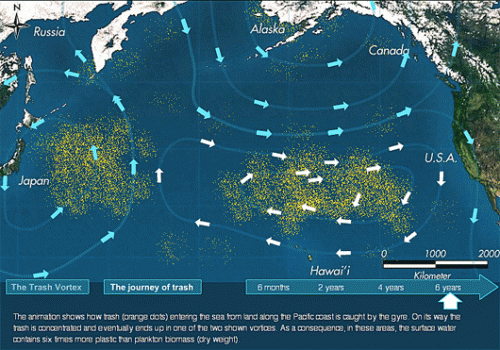
Last week in Environmental Chemistry, I learned about the big circling collection of garbage in the oceans. The whole time I was reading ch. 6 of Rosland, I had this picture in my mind. It is really disgusting to see this amount of trash and it perfectly exemplifies how much trash we have and how much it is out of control.  There are initiative to remove this trash but the problem is that it just comes right back due to the movement of the ocean currents. Here 'recovering' isn't really an effective answer to the surplus of trash.

The reading brings up an interesting point, people are so focused on recycling and recovering, which are the last of the (four) R's. One of my favorite initiative to reduce is the 'think out side the bottle.' I have saved SO much money not drinking bottled water/tea. I have a britta filter at home and I brew my own Ice tea. It is really not as inconvenient as people might think it is to carry around your own water instead of purchasing it. Not only does it save money, but, in light of the reading, it has a major effect on the planet. We shouldn't need to invest in so much recycling if people would just 'reduce' a little more.


The resistance to change that Americans have toward the environment is crazy. Instead of changing we implement new technologies for recycling and recovering. Like the book says, this kind of misses the whole point of sustainability. We have to change our lifestyles if we are going to be sustainable. Programs like recycling are only a short-term solution. I signed up for the think outside the bottle challenge about two years ago. I can probably still count on two hands the number of water bottles that I have purchased -- I'm pretty proud of that!