Sunday, December 5, 2010

Visions, Conclusions and Definitions of sustainable communities

Visions

The readings this week focused on 'visions' and scenarios of sustainable communities. Common themes that arose in the reading include:

walkable and bike friendly streets, reduced or non-existent motorized vehicles and a high level of social capital


Achieving a sustainable community is a long-term goal and requires participation of all community members. Eliciting the type of participation that a sustainable community requires is, to me, the major hurtle facing communities right now. 

Conclusions

Now, at the end of this course, it is very clear how complicated the subject of sustainable communities are. There are many different avenues to achieve sustainability. In our class we specifically focused on how to become more sustainable in: Food, Water and Energy. I had never before considered, indicators, or ways of measuring sustainability. Furthermore, I realized how much local government support is required in order to make improvements. I never realized that issues, such as building codes would cause so much friction against individuals who are making an effort to move towards sustainability.

The closing ceremony, this past Friday, was a wonderful demonstration, of how thinking in a sustainable can foster interactions and good feelings between people.  Some of the people who visited our class's poster display seemed very intrigued by our recommendations. One man, in particular, asked for more information on our Starter Garden Program. I told him about BCOS and that these are recommendations made to the commission. I urged him to contact them and ask about our recommendations and if they are being used. I think that is a great example of how to get people involved and interested in what is happening in the community.

Definitions

This semester, I have  been presented with a variety of definitions of sustainable communities (many of these definitions, I have made note of throughout this blog).  Now, I present my own definition of sustainability:

Sustainability is the act of preserving our Earth with the intentions of providing food, habitat, and happiness for the current and future generations.

I think that this definition encompasses the basic need of acknowledging that it is the Earth that supports us. It also addresses the fact that being sustainable adds to ones 'happiness' and quality of life. It also shows that we must be forward thinking.  It is true that the definition can quickly become more complicated (as I learned in this course) however, I feel like my definition summarizes most what stood out for me this semester.

Saturday, November 27, 2010

Governing Sustainable Communities

I was happy to see a strong role of people and the local government with a underemphasis of federal government and lobbyists. One of the secondary factors associated with sustainable communities is the building of ties, social capital, among people. In other words:

In a sustainable community, people are caring about the environment, 
their government and each other.

I think Bloomington is moving towards the right direction with the Bloomington Commission on Sustainability (BCOS). Meaning they have an avenue for people to come and talk to the local government. Unfortunately, from what I can tell from attending a meeting. There doesn't seem to be too much community participation. Even the commission seems too overwhelmed with day to day life to work on outreaching to the community.  I hate sounding pessimistic, but I am wondering what steps need to be taken before you have a scenario as the one described in the book; where people in the community are being very active in decision making, building the local economy and social capitol. Looking at Bloomington, it seems like something is missing. It could be the population size, a transient population... I don't know. The chapter didn't even provide a concrete example of a community functioning like this.

Basically, in conclusion, I completely agree with the book that this is the way to go, I would just like to know how to get there.

Tuesday, November 23, 2010

Themester Event #3

Moving U.S. Climate Policy Forward: Are Carbon Tax Shifts the Only Good Alternative?
Friday, November 19
by: Ian Perry

First off, the presentation ended being completely over my head and not at all what I expected. The overall conclusion to the talk was:

"Carbon tax shifts may be the only economically sound investment for the U.S."

How Ian Perry arrived at this conclusion, I really have very little idea. His presentation assumed a basic understanding of economics, at the least. I have zero understanding of economics and was therefore lost by the second slide of the presentation. Ian Perry used a variety of graphs to describe carbon taxes and other types of policies.... Used a lot of words and abbreviations that I have never heard before.... I don't know. I thought this was going to be more of a scientific talk. So, sorry I can't give a better summary of the talk. If anybody else could tell me what was going on, I would appreciate it.

Themester Event #2

Film Screening of Food Inc. 
Wednesday, November 10. 


I'm posting about this kind of late... But, I will never buy Tyson chicken again! I went to the grocery store with a friend last week. She went over to pick out some chicken, and of course, the selection was dominated by Tyson products. As soon as she picked up a package, I freaked out on her. "Don't buy that!!" I shouted in the store. She and a few people standing buy gave me a funny look. I asked her if she had ever seen the movie, Food Inc.. Not surprisingly she said no. I told her that there was a reason that she was getting "more for her money" and that it wasn't a good reason. We compared the Tyson chicken package to the organic chicken package. Sure enough, the Tyson chicken was twice as big and twice as cheap as the organic. After telling her that Tyson feeds there chicken bucket loads of hormones and the ground up body parts of deceased chickens...she decided that she really wasn't getting the best deal buy investing in Tyson chicken. I'm not sure if she has seen the movie yet, but I at least felt that I had made some sort of impact.

I have to say, I have not been persuaded to become vegetarian or vegan. Rather, I understand that not all food is equal and that shopping with integrity takes some effort and education. I do appreciate this movie for providing some concrete research rather than just showing picture after picture of abused animals. Although, I have to admit that the scene with the downed cow getting pushed around by the tractor, was appalling.

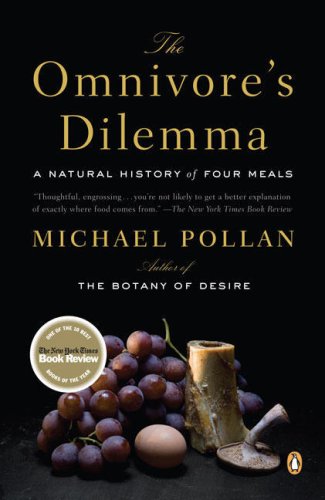
I would definitely recommend this movie to other people who are interested in learning more about where their food comes from. I would also recommend the books by Michael Pollan, Omnivores' Dillema, and Jonathan Foer, Eating Animals. 

Sunday, November 14, 2010

Economic Development

For the most part, my brain starts shutting down when I am faced with the topic of 'economics.' I have never taken an economics class, and I have never really participated in a discussion of economics -- it is way over my head. Thus, when I saw what the topic of this weeks reading was, I was kind of thrown against a wall. After reading, I still feel a lost but I did learn some things:

What is economic growth?

What I can gather, it is a useless way to measure how 'good' things are going. It doesn't seem to be as comprehensive of a definition as it needs to be and is thus not very representative of what is going on.  The essay "The Economic System and Natural Environments" explained it basically as 'spending.' Not spending in a positive way but simply any spending. This was very enlightening but actually functioned to make me even more weary of economics.

Walmart.

In the next section, "Natural Capitalism", all I could think about was Walmart. I hate Walmart. Basically, the author was talking for a little bit about how business are moving toward being 'green.'  While reading this, I was thinking about how many conversations I've been in where I was telling people how much I hate Walmart. The number one rebuttal I keep hearing is that Walmart is doing a much better job with providing 'green' products. Well, no shit they are providing green products! It is what consumers want and if Walmart wants to continue dominating the economy, then they better provide 'green' products!!! Walmart isn't doing it because they care about the environment! They are doing it because they care about money! And that doesn't make them a better company in my book!

Government. 

A few of the sections talked about the size of the Government and how a move to sustainability can decrease the size of the government. I think this is a great thing, however, I couldn't help but think how much our government is trying to grow and control more of the private sector. In fact, it seems to me, at least with the current President, that this is what people want - a bigger government. But at the same time people want sustainability... a little confusing and counter-intuitive. The essay "Preparing for a New Economic Era" even said that the UN summits, focused on human problems, has been relatively ineffective at influencing a lot of change. Change needs to happen on the local level, not the federal, or even, global level. Change on the federal and global level will happen as local communities get it together. 

Imports.

Imports are pretty unavoidable at this point. Especially because we are all pretty much addicted to things like coffee and chocolate! But I think true sustainable communities should strive to limit imports on items that can easily be acquired locally. For example, why by a watermelon from Mexico in the mid-west?? The last two essays in the Sustainable Reader really focused on this topic. Moving away from imports will strengthen local economies and shrink the government even further. 

Conclusion.

The topics above are what stood out for me the most from this weeks reading. I'm pretty sure I'm on topic, but I think I really need to see what comes up in class on Tuesday. I am perfectly aware that there is a tie between natural capital and human economics. I have mostly just chosen to ignore the latter.


Thursday, November 11, 2010

After Wendell Berry's talk

Wendell Berry started his talk with us by providing his own definition of sustainability:

A sustainable community is "one that, so far as possible, would waste nothing. Would make things last. And would convert waste into fertility"  -- "as is true in natural ecosystems"

According to him, there are several ways to achieve a sustainable community. For example, you should keep money circulating in the local community as long as possible, and have as much food as possible produced locally and locally processed. These methods all stem to the renewal of household and local communities. Furthermore, the community must "conserve it's people" and "figure out who the gifted people are" meaning who has the knowledge and experience to implement new sustainable techniques.

Wendell talked about what communities were like back in the 30's and 40's. When talking about sustainability to people, I think it is important to stress that sustainability is not a new thing. According to him, the "idea of health use to be making things last, not spending, as it is today."  People seem to have become lost in the label of the 'consumer.' We need to be more aware and learn to accept what our earth can offer us and not what we think we can squeeze out of it.

Report: Global Warming Issue From 2 Or 3 Years Ago May Still Be Problem

The title of this article was enough to make me laugh -- "May still be a problem".... really, it isn't just going to go away as we continue to abuse our earth?